
Women in Ethiopia’s Coffee Supply Chain: From Harvesting to Export in Jute Coffee Bags
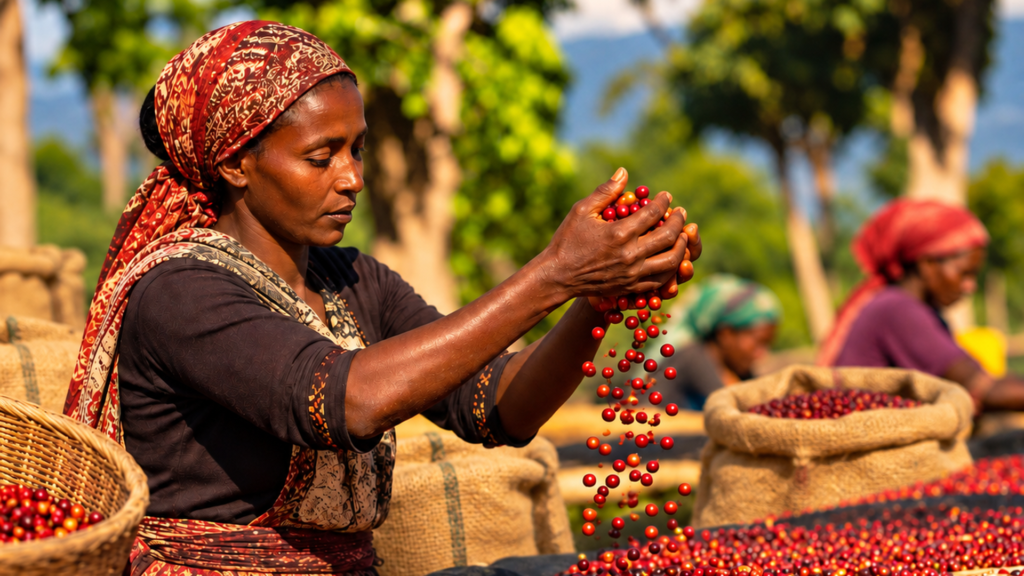
jute coffee bags may be one of the last things international buyers see before Ethiopian green coffee begins its journey overseas. However, the story behind that bag starts much earlier. Across Ethiopia’s coffee-growing communities, women contribute to the work that moves coffee from farms through harvesting, sorting, processing and preparation for market.
Coffee holds exceptional economic and cultural importance in Ethiopia. USDA projects the country’s coffee production at about 11.6 million 60-kg bags for marketing year 2025/26, with exports forecast at 7.8 million bags. Foreign Agricultural Service Behind these large numbers are farmers, workers, processors, cooperatives, traders and exporters. Women form an important part of this human supply chain.
Their work also connects with an important physical part of coffee logistics: packaging. Once processors prepare green coffee beans for storage, handling and export, suitable packaging becomes essential. For generations, natural-fibre sacks have been closely associated with the international coffee trade. Today, jute bags for coffee beans remain a recognizable packaging format for green coffee.
This article follows that journey, from women working within Ethiopia’s coffee communities to the preparation of export coffee in jute coffee bags for international markets.
Women at the Heart of Ethiopia’s Coffee Industry
Ethiopia holds a distinctive position in the global coffee industry as the historic home of Arabica coffee. Coffee also supports livelihoods across farming, processing, trading, transportation and related services. International Coffee Organization material has described the sector as supporting millions of Ethiopians and highlighted the dominance of small-scale production. International Coffee Organization
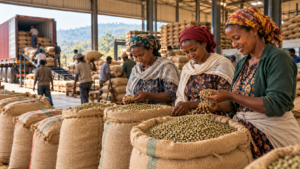
Within this system, women contribute across different stages of the coffee value chain. Their activities can include farm work, harvesting ripe cherries, sorting, drying and other post-harvest operations. Women also participate in processing, trading and coffee-related enterprises, although the exact roles differ by region, household, production system and business.
Historically, participation has not always meant equal economic benefit. An International Coffee Organization report discussing gender equality in the coffee sector cited an African Development Bank study indicating that women represented a large share of Ethiopia’s coffee workforce while controlling a smaller proportion of coffee revenue. The same report highlighted access to land, finance, agricultural extension, training and leadership opportunities as important areas for improving women’s economic participation. International Coffee Organization
More recent work continues to focus on these issues. In 2026, FAO’s Commit to Grow Equality initiative highlighted work involving CARE Ethiopia on practical approaches designed to improve women’s economic outcomes, productivity and market integration in coffee and cocoa value chains. FAOHome
From Coffee Trees to Selective Harvesting
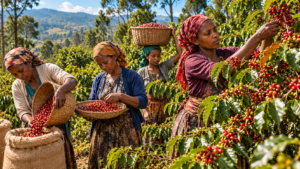
Quality coffee begins with the coffee tree. During harvest, workers need to identify and collect cherries at suitable stages of ripeness. Selective harvesting matters because the condition of the cherry affects the subsequent processing and, ultimately, coffee quality.
Women can take part in harvesting and other farm activities within coffee-producing households and communities. Their contribution therefore begins well before anyone sees a finished coffee bag in a warehouse.
After harvesting, the coffee must move quickly into the appropriate post-harvest process. Ethiopia uses both natural and washed processing systems. International Coffee Organization material notes the long-standing importance of natural or sun-dried processing, in which whole coffee cherries dry before secondary processing. Washed coffee follows a different route, where producers or washing stations remove the pulp and process the parchment coffee. International Coffee Organization
At every stage, careful handling matters. Poor harvesting, drying or storage practices can affect the quality created on the farm.
Women’s Role in Coffee Sorting, Drying and Processing
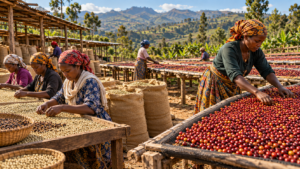
Coffee processing requires many detailed tasks rather than one single operation. Workers may spread coffee for drying, turn it, remove unsuitable material, sort beans and prepare coffee for later grading and marketing. These activities connect farm production with commercial quality.
Research on Ethiopia’s coffee value chain shows that post-harvest practices and processing capacity can influence quality and farmer outcomes. FAO-hosted research also notes the role of wet mills in producing washed coffee and the premium that washed coffee can receive in international markets. FAO AGRIS
Women’s participation in these stages deserves attention because coffee quality depends on consistent work throughout the supply chain. A premium coffee can lose value if workers handle it poorly after harvest. Conversely, careful sorting, drying and processing help preserve the qualities that buyers expect from a particular origin.
Quality Starts Long Before the Coffee Enters a Jute Bag
International coffee buyers often focus on origin, grade, processing method, moisture, cup profile and other commercial specifications. Yet those specifications represent the result of many earlier decisions and activities.
Therefore, jute coffee bags should not be viewed as the beginning of quality management. It is closer to the final physical layer around a product whose quality has already been shaped by farmers and workers.
This distinction is important for packaging buyers as well. A high-quality bag cannot correct poorly processed coffee. Likewise, carefully processed coffee still requires appropriate handling and packaging as it moves through storage and international logistics.
From Ethiopian Coffee Processing to Export Preparation
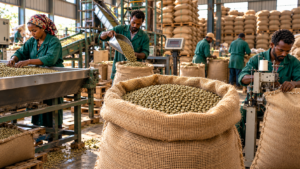
After primary and secondary processing, commercial coffee moves through a more structured supply chain involving producers, cooperatives, processors, traders, warehouses and exporters. Ethiopia’s coffee value chains can follow different routes, and recent research identifies formal, informal, domestic and international chains within the wider sector. FAO AGRIS
For export coffee, quality assessment, grading, lot preparation, storage and commercial documentation become increasingly important. At this stage, packaging is no longer simply a farm-level handling tool. It becomes part of the international logistics system.
USDA forecasts Ethiopian coffee exports at 7.8 million 60-kg bags in 2025/26, supported by global prices and reforms that have expanded international market access. Foreign Agricultural Service Such volumes illustrate the scale of the packaging, warehousing and logistics requirements surrounding the sector.
Why the Jute Coffee Bag Matters for Export Coffee
jute coffee bags provides a practical natural-fibre outer package for green coffee beans. Depending on the buyer’s requirements, coffee exporters may specify bag dimensions, construction, weight, sewing, markings and other features.
Jute fabric offers strength while retaining the recognizable natural appearance associated with traditional coffee sacks. For this reason, buyers searching for coffee hessian bags, jute coffee sacks, burlap coffee bean bags or large burlap coffee bags are often looking for related natural-fibre packaging solutions.
However, the correct specification matters more than the terminology. An importer should not order simply by saying, “I need a coffee jute bag.” The buyer and supplier should establish the actual packing requirement first.
That discussion may cover bag dimensions, required capacity, fabric construction, bag weight, sewing method, printing, bale packing, quantity and destination.
jute coffee bags and the Journey to Global Markets
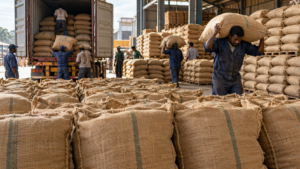
Once exporters fill and close the bags, coffee enters another phase of its journey. Workers handle the bags in warehouses, consolidate shipments and prepare cargo for international transportation.
A suitable jute bag coffee specification needs to support these practical handling requirements. The sack may pass through several physical stages before reaching the overseas buyer. Therefore, stitching, fabric consistency and workmanship matter.
Importers may also require identification marks, origin information, lot references or company-specific printing. Custom jute bags can accommodate agreed markings where the printing and technical specifications are confirmed before production.
For GFTCL, this is where Bangladesh’s jute industry can connect with Ethiopia’s coffee export sector. Bangladesh has a long-established jute manufacturing base, while Ethiopia has a major international coffee industry. The relationship is straightforward: coffee exporters need suitable packaging, and jute suppliers can manufacture bags according to agreed commercial specifications.
Choosing jute bags for coffee beans
A buyer sourcing jute bags for coffee should start with the commodity and supply-chain requirement rather than selecting a bag only by appearance.
Bag size and construction should suit the intended packing quantity. Stitching should support normal filling, lifting and warehouse handling. Printing should remain clear and appropriate for the customer’s identification requirements. Bale packing should also suit shipment and warehouse operations.
The same principle applies to buyers searching online for burlap coffee bags wholesale, burlap coffee bean bags wholesale, burlap coffee sacks for sale, coffee bean burlap sacks for sale or buy burlap coffee bags. Search terminology varies between markets, but professional procurement should eventually become a precise technical specification.
A commercial coffee exporter normally needs new bags manufactured for the intended packing operation. In contrast, terms such as used burlap coffee bags wholesale, used coffee burlap bags, recycled burlap coffee bags, mini burlap coffee bags, small burlap coffee bags and burlap coffee bag tote can relate to secondary, decorative, retail, craft or reuse markets. These should not automatically be treated as equivalent to new export-grade coffee packaging.
Women, Sustainable Coffee and Natural-Fibre Packaging
Sustainability in coffee extends far beyond the material used to make the outer sack. It can involve farming practices, forest protection, livelihoods, gender inclusion, traceability, processing, transport and packaging.
For example, recent research on Ethiopia’s coffee value chain has highlighted the increasing importance of traceability as international market requirements evolve. FAO AGRIS At the same time, organizations working in the coffee sector continue to examine ways to improve women’s access to resources, finance, markets and decision-making opportunities. FAOHome
Natural jute packaging can fit within this wider conversation, but businesses should avoid treating a jute coffee bag alone as proof that an entire coffee supply chain is sustainable. Responsible sourcing requires a broader view.
For buyers, that means asking where coffee comes from, how producers and workers participate in the value chain, how quality and traceability are managed, and how the product is packed and transported.
For packaging suppliers, it means providing clear information about the bag itself rather than making unsupported environmental claims.
How International Coffee Buyers Should Specify a jute coffee bag
Clear specifications reduce misunderstandings between buyers and suppliers. Before requesting a quotation, a coffee company should clearly identify the bag’s intended application and commercial requirements.
For a jute coffee bag order, buyers should confirm the following:
- Coffee Application: Specify that the bag will be used for green coffee beans and explain the intended packing application.
- Bag Dimensions: Provide the required length and width of the jute coffee bag.
- Capacity: Confirm the target weight of coffee to be packed in each bag.
- Fabric: Specify the required jute or hessian fabric construction.
- Bag Weight: Confirm the agreed bag weight or construction specification.
- Sewing: State the required seam, stitching and closure method.
- Printing: Provide requirements for logos, origin details, lot numbers or shipping marks.
- Quantity: Mention the total number of bags required for the order.
- Packing: Confirm the required bale size and packing arrangement for shipment.
- Destination: Provide the destination country and port.
- Trade Terms: Confirm the required Incoterm and quotation basis, such as FOB, CFR or CIF.
These details are especially important for wholesale orders. A supplier can prepare a more accurate quotation when the buyer provides measurable specifications instead of generic descriptions such as burlap bean bags or coffee jute bags.
For larger requirements, buyers should also consider sample approval before bulk production. A sample allows both parties to review the dimensions, fabric construction, sewing, printing and overall workmanship before confirming the full order.
Sourcing jute coffee bags from Bangladesh with GFTCL
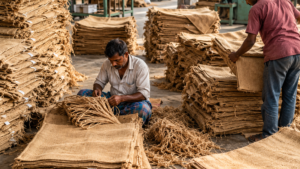
The Golden Fibre Trade Centre Ltd. (GFTCL) supplies jute products from Bangladesh for international markets. For coffee-sector buyers, GFTCL can discuss jute coffee bags requirements according to the buyer’s intended application, specifications, quantity, printing needs and destination.
Buyers searching for jute bags for coffee beans, coffee hessian bags, jute coffee sacks, large burlap coffee bags or broader wholesale jute bags for agro packaging should provide as much technical information as possible when requesting a quotation.
GFTCL’s role is not to determine the coffee grade or processing method. Instead, the company can work with the buyer on the packaging requirement. This distinction helps keep responsibilities clear throughout procurement.
For Ethiopian exporters and international coffee businesses, reliable communication between coffee supplier, packaging supplier, logistics provider and importer can reduce avoidable problems. Confirming specifications before production is a simple but important part of that process.
From Women’s Hands to Coffee Markets Around the World
The story of Ethiopian coffee does not begin in an export warehouse. It begins in coffee-growing landscapes and communities where people nurture trees, harvest cherries and perform the detailed work required to turn a fruit into a globally traded agricultural commodity.
Women form an important part of that story. Their contribution extends through farm and post-harvest activities and into the wider coffee economy. At the same time, continued efforts to improve women’s access to resources, skills, finance, leadership and market opportunities remain relevant to the future of the sector.
Packaging enters much later, but it still has a practical role. Once processors prepare green beans for commercial shipment, a properly specified jute coffee bag helps create a standardized package for handling, storage and export.
That connection from Ethiopian coffee farms and the women who contribute to the supply chain to coffee packed for international trade—shows how many people, processes and materials stand behind an ordinary bag of green coffee.
For importers, roasters, exporters and coffee traders seeking jute bags for coffee from Bangladesh, GFTCL can discuss bag specifications, custom printing, quantities and shipment requirements for international orders.
Frequently Asked Questions (FAQ)
1. What is a jute coffee bag?
A jute coffee bag is a natural-fibre sack made from jute fabric and used as an outer packaging format for green coffee beans. Commercial specifications can vary according to the coffee exporter, importer, destination market and packing requirement.
2. Why are jute bags used for coffee beans?
Jute bags offer a strong and practical format for packing, handling and storing green coffee. They are also widely recognized in international commodity supply chains. Buyers should select the correct dimensions, construction, stitching and other specifications for their particular coffee operation.
3. Can Ethiopian coffee exporters order custom jute coffee bags?
Yes. Subject to manufacturing and order requirements, buyers can specify dimensions, construction, sewing and printing for custom jute bags. Exporters should provide artwork and shipping-mark requirements before bulk production.
4. Are burlap coffee bags and jute coffee bags the same?
The terminology can overlap. In markets such as the United States, people commonly use “burlap” for coarse woven jute fabric and bags. In international jute trade, terms such as hessian, jute sack and jute bag are also common. Buyers should rely on measurable specifications rather than the product name alone.
5. How can coffee buyers request a quotation from GFTCL?
Buyers should provide the required bag size, intended coffee capacity, fabric or construction requirement, bag weight if specified, sewing, printing, order quantity, destination port and preferred trade terms. GFTCL can then review the requirement and discuss an appropriate quotation for the intended application.